Florida |
How a South Florida Drift Dive Actually Runs, From Giant Stride to Pickup
The first time a captain tells you to roll on a green light and the boat is already moving, your instinct is wrong. You want to hold the ladder, sort your camera, check your buddy one more time. Don't. On a Palm Beach drift dive the window is the moment the dive deck calls it, and the whole team going over the side inside ten seconds is the single thing that makes the dive work. Everything else follows from that.
There is no anchor
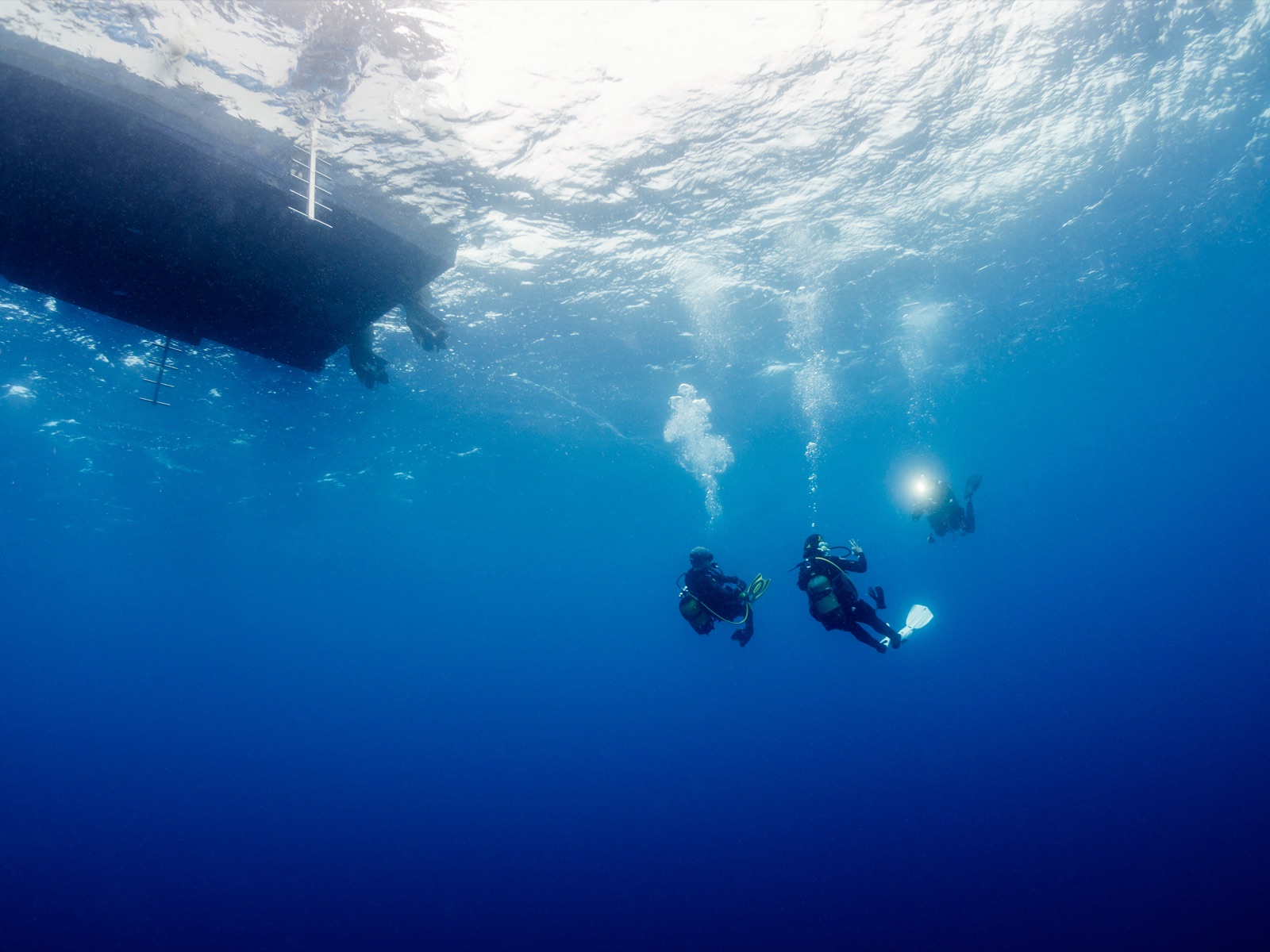
Most divers learn on an anchored boat. You descend a line, you tour the reef, you come back up the same line. A drift dive throws that whole mental model out. The boat is not tied to anything. It sits in the Gulf Stream, engines on, and so do you the second you hit the water. The reef slides past underneath while the current carries you and the boat in roughly the same direction at roughly the same speed.
That is the part new drift divers underestimate. You are not swimming a route. You are falling sideways through the water column with a reef for scenery, and your job is to manage depth and buoyancy while the ocean handles distance. I tell first-timers to keep their fins still for the first two minutes and just feel it. Once you trust that the current is doing the work, you stop fighting it, and your gas lasts.
Why the captain wants everyone down together
On the surface, a captain can only watch one cluster of bubbles. If half the team drops on the call and the other half fumbles at the ladder, you have now created two groups separated by current, and the boat cannot babysit both. That is how a diver ends up alone in open water a quarter mile from anyone.
So the protocol is blunt. Final buddy check happens at the gunwale, not in the water. Regulator in, computer on, air on, SPG verified, light clipped. When the call comes, you go. A clean drop puts eight people in a tight knot at the surface that descends as one. I have run dives where the group hit the reef looking like a formation, and I have run dives where one slow diver turned a simple reef into a search. The difference was always the giant stride, not anything that happened at depth.
How the current actually reads down there
The Gulf Stream is not uniform. It runs harder on the outside of the reef line and softens in the lee of ledges and wreck structure. Good drift divers use that. Tuck behind a coral head and the flow eases enough to hang and watch a turtle clean up at a station. Drift two feet over the top of the same ledge and you are gone, moving at a walking pace whether you like it or not.
Read it by watching the soft corals. Sea fans and whips lay over in the direction of flow, and the angle tells you how hard it is running. When they are flat, you hold position by hiding low, not by kicking into it. Kicking into a two-knot current is a way to suck a tank dry and accomplish nothing. The reef wins that fight every time.
The float, the flag, and who carries it
Somebody in the water carries the surface signal, and the captain watches it the entire dive. On most South Florida boats that is the divemaster trailing a float and dive flag on a reel, and the float is what the captain actually tracks across the surface. Your bubbles are secondary. The flag is the dive.
If you are diving without a guide, one buddy team needs to own that float. The captain is not following the prettiest reef or the diver with the camera. He is following the flag, and he is staying off it so the prop is never anywhere near the line. This matters for a practical reason: if you drift away from the flag, you have drifted away from the only thing the boat is steering by. Stay within sight of it and you stay found.
Late in the dive, the rule tightens. As the group thins out on gas, everyone closes in on the float so the surfacing happens in one spot, near one marker, in front of one captain who already knows where to point the bow.
Coming up is a team event, not a solo one
On a line dive you ascend when your gauge says so. On a drift dive you ascend when the team does, or you signal the divemaster and surface near the flag with your buddy. The reason is the pickup. A boat can make one clean approach to a tight group at the surface. It cannot make six approaches to six divers scattered across a hundred yards of moving water, not safely, not with the current pushing everyone in slightly different directions.
Send up your own delayed surface marker buoy before you leave the bottom if you are surfacing away from the group. A bright bag standing up off a spool gives the captain a second target and gives you a visible safety stop reference in midwater where there is nothing else to hold depth against. Three minutes at fifteen feet in open blue water is harder than it sounds. The bag fixes it.
The pickup itself
When you surface, get positive, get your face out of the chop, and turn to find the boat before you do anything else. Then wait. The captain approaches from down-current so the boat drifts onto you rather than running over you, and he brings the ladder to the group in an order that keeps the engine clear of bodies. You swim to the ladder only when waved in. Until then you hold your spot and keep an eye on the hull.
Get a hand on the ladder, get your fins ready to hand up or to climb in, and clear it fast. The next diver is right behind you and the boat is still in current the whole time. A slow ladder is the same problem as a slow giant stride, just at the other end of the dive. Speed on the metal keeps the whole pickup tight.
Before you book the boat
If you are new to live-boat diving, say so at the dock. A good crew will put you near the front of the drop order and keep the divemaster within arm's reach for the descent. None of this is hard once the rhythm clicks, and after a handful of dives the live boat feels easier than chasing an anchor line in current. Get the giant stride right and the rest of the Gulf Stream is just scenery sliding by.