
Dive Computers |
Shearwater Perdix 2 vs Teric: Pick by Use Case, Not the Spec Sheet
I get this question on the boat almost every week. Someone has decided they want a Shearwater — good instinct — and then they freeze between the Perdix 2 and the Teric. They start pulling up spec sheets on their phone, comparing them line by line, and they end up more confused than when they started. That's because the spec sheet is mostly going to tell you the two computers are the same. The interesting differences aren't on it.
So this isn't a re-review of either unit. We've got fuller standalone reviews of both the Perdix 2 and the Teric elsewhere on the site if you want the deep dive on each. This is the decision piece: which one should you actually buy, based on the kind of diving you do and how you live with gear between dives.
Same brain, different body
Let's clear the deck first, because it saves a lot of pointless deliberation. On the things people think separate these two, they're identical.
- Both are Shearwater, with the same clean menu logic and the same color display philosophy.
- Both run Bühlmann ZHL-16C with Gradient Factors. Same decompression math. If you set the same GF Lo/Hi on each, they'll give you the same plan.
- Both do air, nitrox, trimix, gauge, and closed-circuit (rebreather) modes. There's no "the Teric is the recreational one" — it isn't. They're both full tech-capable computers.
- Both support air integration through Shearwater's Bluetooth transmitters, so you can read tank pressure and gas-time-remaining on the wrist or puck.
- Both have a digital compass.
That's the part that matters most and gets overlooked: there is no capability gap here. You are not buying more diving ability with one over the other. Whatever you can plan and execute on a Perdix 2, you can plan and execute on a Teric. So if capability isn't the deciding factor — and it genuinely isn't — what is? Four things: form factor, screen, battery, and whether you want to wear the thing off the boat.
Screen and legibility
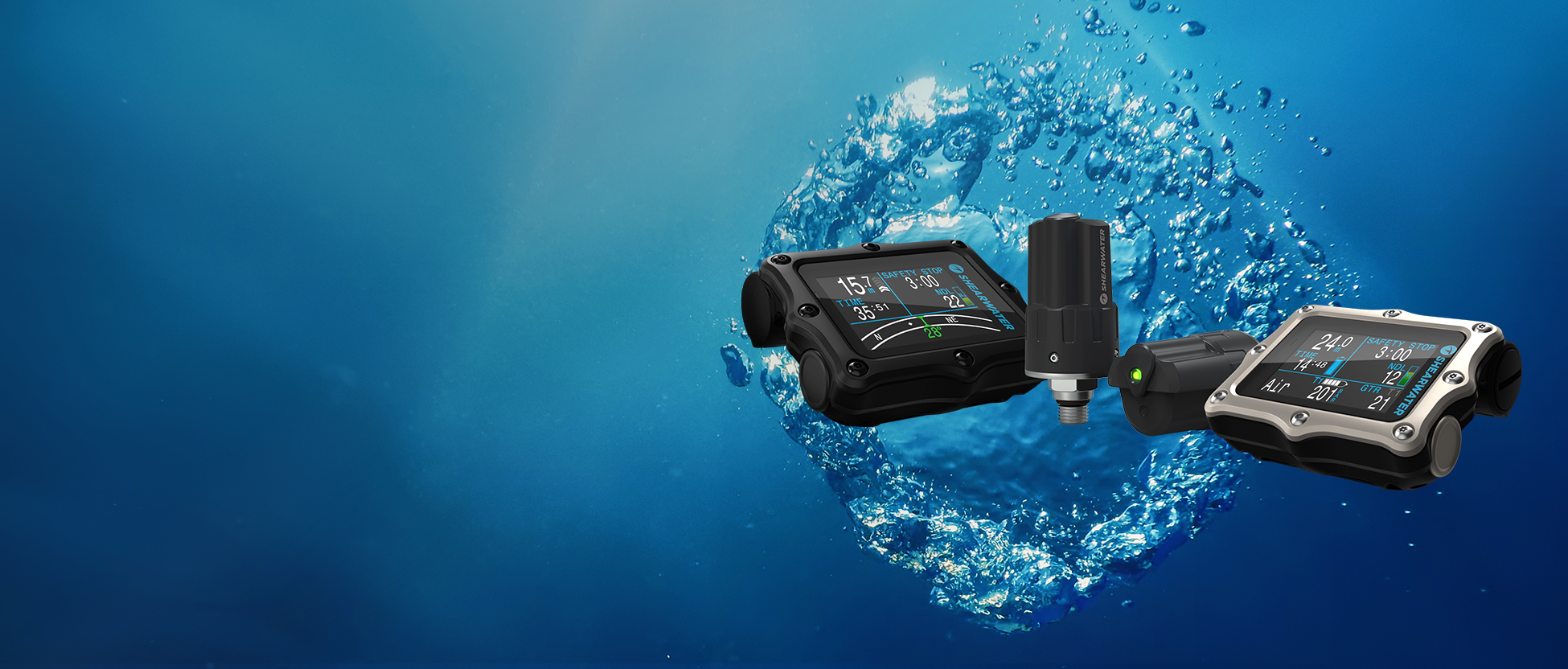
The Perdix 2 is a dedicated dive-computer puck. It's big. The screen is big, and that's the whole point of it. When you're at depth, in cold-ish or low-viz water, with a mask compressing your field of view and maybe a hood pinching your peripheral vision, a large high-contrast display you can read in a half-second glance is worth a lot. You look down, you get your number, you go back to the dive.
The Teric uses a smaller AMOLED display. Don't read "smaller" as "bad" — it's a genuinely bright, sharp, good-looking screen, and most divers read it fine. But it is physically smaller, and there's no engineering its way around the fact that a watch-sized face shows less than a puck-sized face.
Here's the practical line I draw. If your eyes aren't what they used to be — and a lot of us cross that bridge in our forties whether we admit it or not — or if you regularly dive dark, green, silty water where everything is a fight to see, the Perdix 2's larger screen is a real, daily quality-of-life advantage. If you've got good close vision and you mostly dive decent viz, the Teric's screen will not hold you back.
Battery: replaceable vs rechargeable
This is the difference that quietly decides it for a lot of people, and it's the one the spec sheet underplays.
The Perdix 2 uses a user-replaceable battery. You can swap a cell yourself, in the field, with no special tools and no dock. If it dies the night before a dive, you pull the old one and drop in a fresh one and you're diving. There's no charger to remember, no cable to pack, nothing to plug in at a hotel with sketchy outlets. For travel and especially for liveaboards — where you might be doing four or five dives a day for a week with no reliable downtime to charge anything — that "I will never be grounded by a dead battery" property is genuinely valuable. You just carry a spare cell in your save-a-dive kit and stop thinking about it.
The Teric is rechargeable via an inductive (wireless) charger. For everyday life this is the nicer experience — drop it on the pad, it tops up, done, and there's no battery hatch to maintain. The tradeoffs are the flip side of the Perdix's strengths: it's one more thing to charge and one more proprietary charger to pack, and crucially you cannot field-swap it. If you forget the charger on a trip, or you forget to charge it the night before an early boat, your options are limited in a way they never are with a replaceable cell.
Neither approach is wrong. It's a question of which failure mode you'd rather never face: managing a charge cycle, or maintaining a battery hatch and carrying a spare cell.
The everyday-wear factor
This is the Teric's home turf, and it's a real reason to buy one.
The Teric is watch-sized. You can wear it to dinner, to the office, on the plane, every day, and it just reads as a watch. It has activity and timekeeping features that make sense to keep on your wrist when you're not diving. For people who like the idea of one device they put on in the morning and dive with in the afternoon, that's a legitimately nice way to live — and it means the computer is always on you, never left in the gear bag.
The Perdix 2 is not that. Nobody wears a Perdix to dinner. It's a tool you put on to dive and take off after. It's bigger, it's clearly a piece of dive equipment, and it lives in your kit between trips. That's not a knock — a wrench isn't worse than a multi-tool because you don't carry it in your pocket — it's just a different relationship with the device.
What about price?
The two land close enough that I wouldn't make the decision on cost. They're in comparable territory, and street pricing moves around with bundles, transmitter deals, and whatever your local shop is running. If one happens to be meaningfully discounted when you're buying, fine, let that break a tie — but don't talk yourself into the wrong form factor to save a little. You'll be living with this thing for years, and the daily ergonomics matter far more than a one-time difference.
How I'd choose
Strip it all down and it's really one question: do you want a watch you can dive, or a dive computer you put on to dive?
I'd reach for the Perdix 2 if:
- You travel or do liveaboards and the phrase "depend on a charger" makes you twitch. A spare cell beats a charger every time you're far from home.
- You want maximum at-a-glance legibility — older eyes, low viz, cold-water gloves, or just a preference for a big clear number.
- You're doing serious deco or technical diving where reading your display instantly under task load matters. A lot of tech divers lean Perdix for exactly this, and the field-swappable battery is one less variable on a trip.
I'd reach for the Teric if:
- You want one device you wear every day, not just on dive days.
- You value the watch form factor and the everyday features that come with it.
- You're fine managing a charge cycle and packing the charger — and you mostly dive conditions where the smaller screen is a non-issue.
And here's the honest part: you cannot make a bad choice here. Both are excellent, both run the same proven algorithm, both will handle everything from a reef dive to a trimix deco profile. I've watched plenty of divers go either way and never regret it. The only regret I see is when someone buys the puck and secretly wanted a watch, or buys the watch and then squints at it in green water wishing it were bigger. So decide on the body, not the brain — because the brain is the same either way.
If you already know which way you lean, our standalone reviews go deeper on the day-to-day of each. But for most people, the four factors above settle it before you ever open a spec sheet.