Jupiter |
When and Where to Dive Goliath Grouper Season in Jupiter
I have dropped onto a lot of wrecks off Jupiter over the years, in every season and every mood the Gulf Stream is capable of. Nothing in our local diving compares to what happens in late summer, when the goliath grouper show up to spawn. You roll off the boat, the wreck materializes out of the blue at ninety feet, and there are dozens of fish down there the size of small cars hanging in the structure like furniture. The first time it stops being normal water and starts feeling like something genuinely big is happening underneath you.
This is a field report, not a brochure. I want to tell you honestly what the season is, when to go, which wrecks deliver, and how the dive actually runs — because it is a drift dive in real current at real depth, and that matters a lot for whether you have a good day or a scary one.
Why August and September
Goliath grouper (Epinephelus itajara) spend most of the year scattered around as solitary, territorial fish. But once a year, in our warm late-summer water, they gather to spawn. Off the Jupiter and Palm Beach wrecks that aggregation roughly runs August into September, and the action tends to peak around the new and full moons. Lunar timing is not a switch that flips on a single day — it is a tendency — but if you can plan your trip around a moon phase in that window, you are stacking the odds in your favor.
What you get for going at the right time is numbers. Outside the season you might find a couple of resident goliaths parked on a wreck. During the aggregation, the same wreck can hold dozens, and on a strong year the bigger wrecks can stack up well into the hundreds. That density is the whole point. It is the difference between "I saw a big grouper" and "I dropped into a crowd of them."
The fish themselves
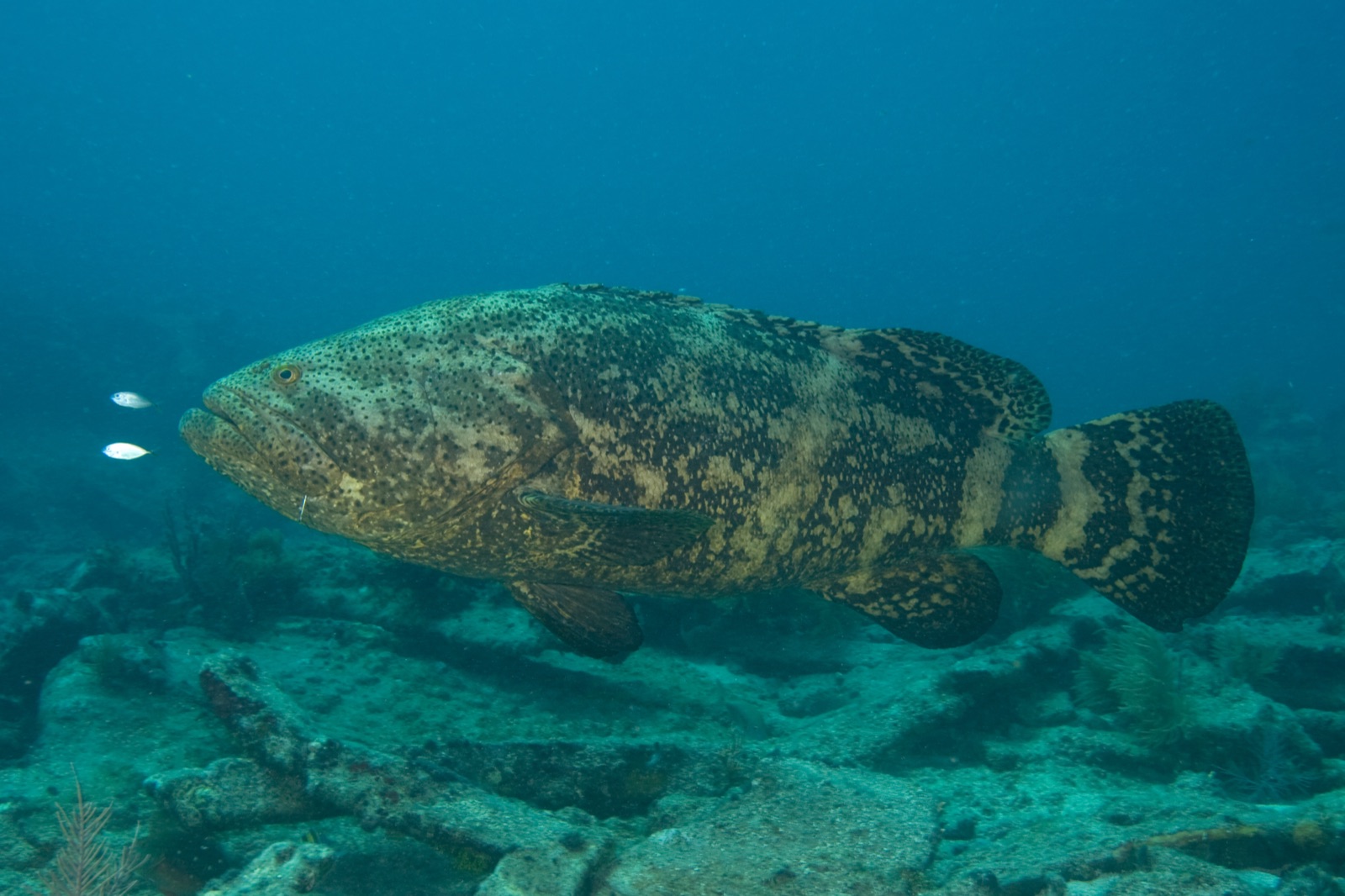
People who have never seen one in the water underestimate the scale. Adult goliath grouper run into the hundreds of pounds, and the largest individuals can push several hundred pounds and stretch to seven or eight feet. Up close they are calm, slow, and almost indifferent to you — they did not get that big by being twitchy. They will hold their ground, watch you with that enormous downturned mouth, and let you drift past at a respectful distance.
The thing nobody warns you about the first time is the sound. Goliaths produce a low, percussive "boom" — a single deep concussion you feel in your chest more than hear. It is a warning and a territorial signal, and when one fires off a few feet behind you it will absolutely make you flinch. It is harmless. It is also one of the most memorable things you will ever experience underwater. If a big one booms at you, you are too close or in its space; give it room and it settles right back down.
Which wrecks
The aggregation concentrates on the artificial reef and wreck cluster off Jupiter sitting in roughly the 85 to 100 foot range. A few names come up over and over with the local boats:
- The Esso Bonaire — an old freighter in the MG-111 area that is one of the classic goliath wrecks and reliably holds fish during the season.
- The Zion Train — another popular structure in the same general depth band that aggregates well.
- The broader wreck cluster in ~85–100 ft — there are several sunk structures grouped within a short run of each other, and on a good day captains will hop between them depending on where the fish and the current are cooperating.
I am deliberately speaking qualitatively about exact positions and the precise count on any given wreck, because both move. Wrecks shift in how they fish year to year, the grouper redistribute between structures, and the smart move is to listen to the captain who has been on these numbers all summer rather than to lock onto one name. If you want to orient yourself before a trip, our Jupiter dive-site notes and the conditions tool on the site are a decent starting point for getting a feel for the area, but the boat's read of the day is what counts.
It's a drift dive — here's how it runs
This is the part that separates Jupiter from a lot of other places people picture when they hear "wreck dive." We are diving in the Gulf Stream. The current is almost always moving, sometimes briskly, and you do not anchor and lazily explore. You drift, and the whole operation is built around that.
Here is how a normal live-boat drift on these wrecks works:
- The whole team drops together. The captain lines up the boat up-current of the wreck, gives the signal, and everyone goes in at once in a tight group. You are not trickling off the back over five minutes — a strung-out team gets strung out across a half mile of ocean. Be ready, gear checked, and go on the call.
- You descend as a unit and let the current carry you onto the structure. Done right, you arrive on the wreck together with the grouper right there in front of you.
- The dive leader carries and deploys a DSMB (surface marker buoy) so the captain on the surface always knows where the group is. In a drift, that float is your lifeline — it is how the boat keeps you in sight.
- The captain tracks the float, not an anchor line. The boat follows you across the surface for the whole dive.
- At the end you ascend along your group's line, do your safety stop in the blue, surface near the marker, and the boat comes to you for pickup. You do not swim back to a fixed point; there is no fixed point.
If you have only ever done anchored or shore dives, the live-boat drift takes a mental adjustment. Stay with your group, keep the dive leader and the DSMB in sight, and do not go chasing one specific fish off into the current on your own. The ocean is moving; respect it and it is a wonderful way to dive.
Protected species — behave accordingly
This matters and I will not soften it. Goliath grouper are a protected species. Harvest has been prohibited in Florida and U.S. federal waters for decades — the population was hammered to near-collapse and the closure is a big part of why we get to have a season like this at all. You do not spearfish goliath grouper. Period.
Beyond the hard rule on harvest, use some judgment around a spawning aggregation. Spearfishing other species in and around a dense aggregation of spawning grouper is discouraged, can disturb the animals during a critical time, and may be subject to additional regulation in these areas. The whole reason the wrecks are spectacular in August is that the fish trust the place enough to gather there. Do not be the diver who wrecks that. Keep your distance, do not corner or ride the animals, do not chase, and let them do what they came to do. If one booms at you, that is the fish telling you you have crowded it — back off.
Planning the day and the experience level
Be honest with yourself about whether you are ready for these dives. This is an advanced / Advanced Open Water level situation, and it is the combination that makes it so: you have depth (90 to 100 feet) and current (the Gulf Stream) and a live-boat drift profile all at the same time. Any one of those is manageable. Stacked together they reward divers who are comfortable, current on their skills, and good on their gas and buoyancy. If you are newly certified, this is a great goal to build toward — not your fifth dive.
A few practical notes for the day:
- Depth limits your bottom time. At ninety-plus feet you are burning gas and accumulating nitrogen quickly, so these are not leisurely hour-long dives. Watch your computer, watch your air, and turn the dive on a plan, not on a feeling.
- Plan a real surface interval. Most boats run two-tank trips out here, and the second dive is repetitive and still deep. Give your surface interval its due, hydrate, stay out of the worst of the sun, and let your nitrogen offgas before you go back down to ninety feet.
- Nitrox is your friend. A appropriate nitrox mix extends your no-deco time at these depths and gives you more comfortable margins across two dives. If you are nitrox certified, use it.
- Carry your own DSMB and know how to shoot it, even if the leader is the primary float. In a drift you want to be self-sufficient on the surface.
- Watch the conditions before you commit. Summer in South Florida means afternoon storms and variable current. A blown-out day is no day for a deep drift. Check the forecast, check the current, and trust the captain's call if a trip gets moved.
When it all lines up — right moon, clean water, a captain who knows the numbers, and a team that drops together — a goliath grouper dive off Jupiter is the best thing we do here all year. You drift onto a wreck at ninety feet and you are surrounded by giants that could not care less about you, the whole structure humming with that occasional chest-deep boom. Go in August. Go ready. And leave the fish exactly as you found them.