dive-computer |
Garmin Descent Mk2i Review: The Dive Smartwatch, Honestly Assessed
I have worn the Garmin Descent Mk2i nearly every day for the better part of a year — to work, on training runs along the Riviera Beach seawall, and underwater off Jupiter most weekends. That is the whole point of this watch, and it is the only honest way to review it. The Mk2i is not a dive computer you strap on at the boat ramp and pull off at the dock. It asks to be your watch. So the question is not just "does it dive well," but "does it earn the wrist time the rest of the week, and does it still keep you safe at 90 feet?" My answer to both is yes, with caveats worth understanding before you spend.
What it is
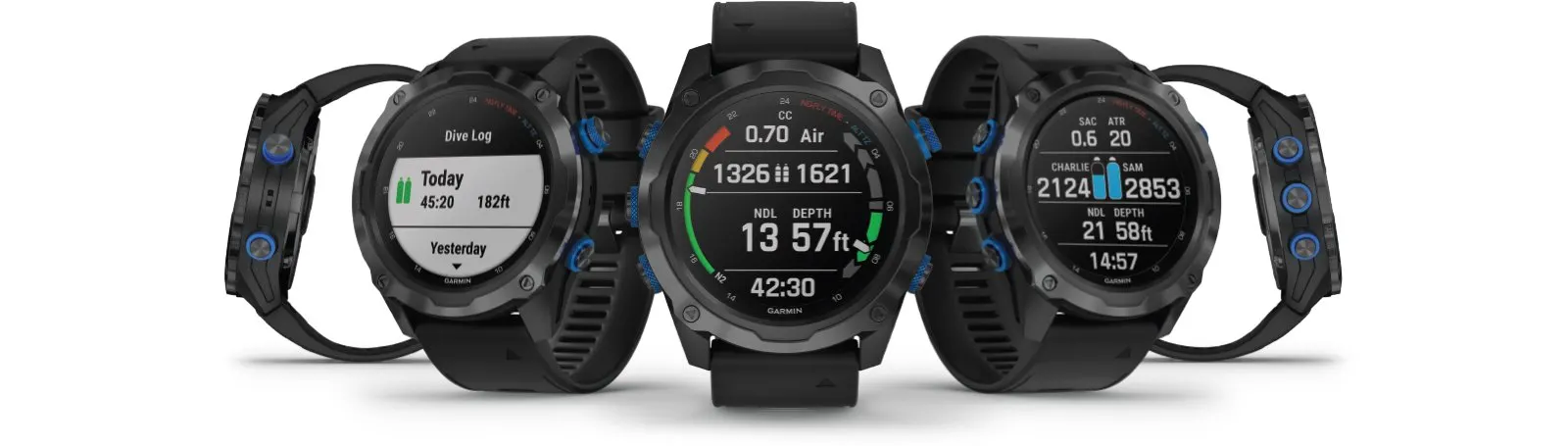
The Descent Mk2i is a full multisport GPS smartwatch that also happens to be a full-featured dive computer. On the surface side it is essentially a high-end Garmin fitness watch: running, cycling, swimming, strength, hiking, with onboard GPS, topographic and dive-site maps, music storage, contactless pay, smartphone notifications, sleep and heart-rate tracking, pulse ox, the usual Garmin stack. It is a large watch with a titanium bezel and a sapphire-style lens, built to survive being knocked around.
One correction up front, because it matters for divers: the screen is not AMOLED. It is a transflective memory-in-pixel (MIP) color display. That sounds like a downgrade until you are squinting at a bright sandy bottom in midday Florida sun — MIP gets brighter and clearer the more light hits it, and it is always-on without murdering battery. It is genuinely one of the most sunlight-legible dive displays I have used. It is not as punchy as an AMOLED phone screen in a dark room, and it leans on the backlight in low viz or at depth. That is the right tradeoff for diving.
On the dive side it is not a stripped "watch mode." It runs single-gas and multi-gas nitrox, trimix, gauge, CCR, and apnea modes, on a Bühlmann ZHL-16C algorithm with adjustable gradient factors. The Mk2i's headline feature over the plain Mk2 is air integration via the Descent T1 transmitter, which is sold or bundled separately depending on the package.
What it does well
The air integration is the standout, and it works differently from most. The T1 transmitter does not push tank pressure over conventional RF — it uses sonar, an acoustic signal through the water, which Garmin calls SubWave. In practice this means I can read multiple tank pressures on my wrist without a hose, and the signal is robust in the kind of murky, particulate-heavy water the Blue Heron Bridge serves up on a bad tide. I have had RF transmitters drop out when the transmitter ends up shadowed behind a tank or a buddy; the sonar approach has been more forgiving for me. You can also monitor a buddy's or student's pressure on a shared setup, which is genuinely useful when I'm shepherding newer divers.
The display legibility I already mentioned — under a hard Florida sun on a drift dive, it just reads. Battery is the other quiet win. In smartwatch mode it goes weeks between charges, which is the entire reason a dive smartwatch is viable: you don't think about it. Dive mode burns far faster, naturally, but I have never come close to running it down across a two- or three-dive day, and topping it off the night before a charter is a non-issue.
The logging and post-dive review are excellent. Dive profiles sync to Garmin's app cleanly, GPS auto-marks your entry and exit points, and it folds into the same ecosystem that already holds my runs and sleep. For a data-minded diver who wants one continuous record of training and diving, that integration is hard to beat. The build quality is reassuring too — titanium bezel, serious water rating, and it has shrugged off boat ladders and tank bangs without complaint.
Where it falls short
It is a big watch. On my wrist it's fine, but it is undeniably tall and broad as an everyday timepiece, and under a thick wetsuit cuff or a drysuit seal it can be a wrestling match to position where I can actually read it. If you have smaller wrists, try it on before you commit.
The dive UX, while complete, is not as ruthlessly optimized as a purpose-built dive computer. The button-driven menus reflect a watch that has to do a hundred non-dive things, so getting to a specific dive setting takes more presses than I'd like. The information hierarchy on the dive screen is good but not as instantly parseable underwater as a computer designed for nothing but diving. You learn it, and then it's second nature — but there is a learning curve, and underwater is not where I want to be learning menus.
Then there is price. This is an expensive watch — roughly in the fifteen-hundred-dollar neighborhood depending on configuration, and the T1 transmitter adds cost on top unless you buy a bundle. You are paying a premium for the smartwatch-plus-dive-computer convergence. If you only ever want a dive computer, you are spending a lot on capabilities you'll use on land.
Compared to a dedicated dive computer
This is the decision that actually matters, so let me be direct. A purpose-built dive computer — a Shearwater being the obvious benchmark — does one job and does it with a clarity the Garmin can't quite match underwater. The screen layout, the large legible numbers, the dead-simple in-water navigation, the no-nonsense menus: a dedicated computer is built so that at depth, narced or task-loaded, you can read your data in a glance and change a setting without thinking. For pure diving, especially technical diving where I want the least possible friction between me and my numbers, the dedicated computer still wins. It is the tool I'd hand a new tech student.
But that comparison cuts both ways. A Shearwater lives in my dive bag. The Mk2i lives on my wrist seven days a week, tracking my training, my sleep, my recovery, and then it dives. For a working recreational and light-tech diver who also runs and lifts and wants one device for the whole life, that convergence has real value that a single-purpose computer simply doesn't offer. The Garmin's algorithm and conservatism settings are credible and standard; the difference is not safety, it's optimization and ergonomics. You are trading a sliver of underwater UX polish for an enormous amount of everyday usefulness.
Who should buy this
Buy the Mk2i if you are an active, data-driven diver who wants a genuine everyday smartwatch that also handles your diving — recreational through moderate tech — and you value carrying one device instead of two. If you already live in Garmin's ecosystem, the case is even stronger, and the sonar air integration is a legitimately good feature that performs in dirty water.
Skip it if you want the most optimized possible dive instrument and nothing else, if budget is tight and a watch is just a watch to you, or if a large watch won't sit right on your wrist. In those cases a dedicated dive computer gives you more diving capability per dollar and a cleaner underwater experience.
My verdict: the Descent Mk2i is the best execution I have used of the "smartwatch that genuinely dives" idea. It does not unseat a dedicated computer as the purest diving tool, and it doesn't try to. It wins on a different axis — being the one device you actually wear all the time — and on that axis it is excellent. I keep it on my wrist on purpose, and that is the highest compliment I can pay a piece of gear.