CCR |
Bailout Gas Planning for South Florida CCR Drift Dives
Bailout is the part of rebreather diving where I see the most hand-waving, and it's the part I think about the hardest before I roll off the boat. On open circuit you breathe your back gas the whole dive, so the gas you started with is the gas that gets you home. On a closed-circuit rebreather the math inverts: you breathe almost nothing from open circuit during a normal dive, which means the day your loop goes bad, every breath of the ascent — and any decompression you've earned — comes off the bailout cylinders strapped to your rig. Plan those wrong and the rest of the dive doesn't matter.
This is how I reason about bailout for the drift profiles we run out of Jupiter and Riviera Beach. It is one diver's thinking, written down. It is not a training course, not a standard, and not a substitute for the procedures your agency and your instructor taught you. The numbers below are deliberately round and illustrative so you can follow the logic — they are not values to copy onto your slate. Plan your own dives against your own training, your own machine, and your own gas standards.
Why rock-bottom doesn't port over
On open circuit, "rock bottom" (or minimum gas) is the volume you reserve so that if your buddy goes to zero at the worst moment, two of you can share and ascend safely. It's built around continuous open-circuit consumption for the whole profile, because that's how you were already breathing.
On a CCR, the framing is different. During a healthy dive you're sipping a trickle of diluent and oxygen, so your open-circuit reserve isn't really a "share with a buddy" number — it's a "the loop is gone and I am now an open-circuit diver who has to leave" number. The trigger event is a loop failure: a flood, a caustic cocktail, a cell or electronics problem I don't trust, a CO2 issue. When that happens I'm off the loop and committed to surfacing on bailout. So the question isn't "how much gas to share," it's "can I, by myself, get from the worst point in this dive to the surface — completing every required stop — on the gas I'm physically carrying?"
The worst point is almost always max depth at the end of bottom time: deepest average depth on the way up, and the most decompression already accrued. If my bailout covers that moment, it covers the easier ones.
The core bailout math
The volume itself is ordinary gas-planning arithmetic. For any segment of the ascent:
- Average depth in ATA — roughly (depth in feet ÷ 33) + 1. Use the average depth of the segment, not the bottom depth.
- × a stressed breathing rate (RMV/SAC) — and this is the part people cheat on. The moment you bail off a failed loop you are working, possibly task-loaded, possibly scared. I do not plan bailout at my relaxed surface rate. I plan it at an elevated, stressed rate. Illustratively I'll use something like 0.75 to 1.0 cubic feet per minute for the bailout scenario instead of the much lower number I'd see on a calm dive. That cushion is the whole point.
- × the time spent in that segment — controlled ascent time plus any stop time at that depth band.
Multiply, sum the segments, and that's your minimum required bailout volume for the deep portion. Then I do the same accounting for the shallower stops on whatever deco gas I'm carrying. A useful sanity habit: walk the ascent in chunks (bottom-to-first-stop, then each stop band) rather than treating it as one average, because the deep chunk dominates and you don't want to smear it into the cheap shallow time.
Two principles I hold to. First, I round up at every step — depth, rate, and time. Second, the answer is a floor, not a target: I want margin above the calculated minimum, not a cylinder that's theoretically "exactly enough." If the number says I need it, I carry more than that.
100 ft vs 180 ft
This is where cylinder choice stops being abstract. The same machine, the same diver, two very different bailout pictures.
A ~100 ft Jupiter reef or wreck drift
At rec-ish CCR depths with little or no real deco obligation, the bailout ascent is short and shallow. Average depth is modest, the time to the surface is small, and there's no meaningful stop time to fund. A single appropriately sized open-circuit bailout cylinder — think along the lines of an AL40, or an AL80 if I want more comfort and the dive is at the deeper/longer end — carrying a mix breathable at that depth covers the worst-moment ascent with margin. The arithmetic just doesn't demand much here, and the honest answer is that a single, well-chosen stage does the job.
A ~180 ft deep-wreck dive with real deco
Now the picture changes on every axis. Average depth on the deep portion is far higher, so each minute costs much more gas. You've accrued genuine decompression, so you're not just ascending — you're stopping, sometimes for a while, and every one of those minutes is breathing off your back. And you need the right gas for the right depth: a bottom-mix bailout for the deep segment, plus a richer decompression gas (and often pure oxygen for the shallow stops) to make those stops efficient and survivable.
So the single AL80 becomes a set of stages: a bottom bailout sized for the deep ascent, plus one or more deco-gas cylinders. The volume grows because depth, time, and stop obligation all grew together. This is the qualitative thing I want newer CCR divers to internalize — bailout demand doesn't scale linearly with depth, it compounds, because deeper dives bring both higher per-minute cost and more total minutes in the form of deco.
Deco if the loop dies
If the loop fails mid-deco, the obligation doesn't politely disappear. I bail to open circuit and I complete the decompression on open circuit. That's the whole reason the deco gas is on my rig and not back on the boat. For the shallow stops, a rich deco mix or oxygen does the same job it would on an OC tech dive: it accelerates off-gassing and shrinks stop time, which in turn shrinks how much gas the stops consume — a nice reinforcing loop, but only if the cylinder is actually there and actually analyzed.
I plan deco gas conservatively too. The bailout deco schedule may run longer than the closed-circuit plan I'd been flying, because open-circuit deco and a high-setpoint CCR deco aren't the same schedule. I'd rather carry gas for a slightly ugly, slightly extended open-circuit ascent than discover at 70 ft that I budgeted for the pretty version. If you want to feel how depth and gas choice move a schedule, the gas-planning and deco-planner tools here on Stoic Diver are a decent place to sketch scenarios — but they're scratchpads for understanding, not a green light to dive a plan your training doesn't support.
Drift changes the team plan
Everything above is volume. Drift adds a logistics problem on top of it, and on a rebreather that problem has teeth.
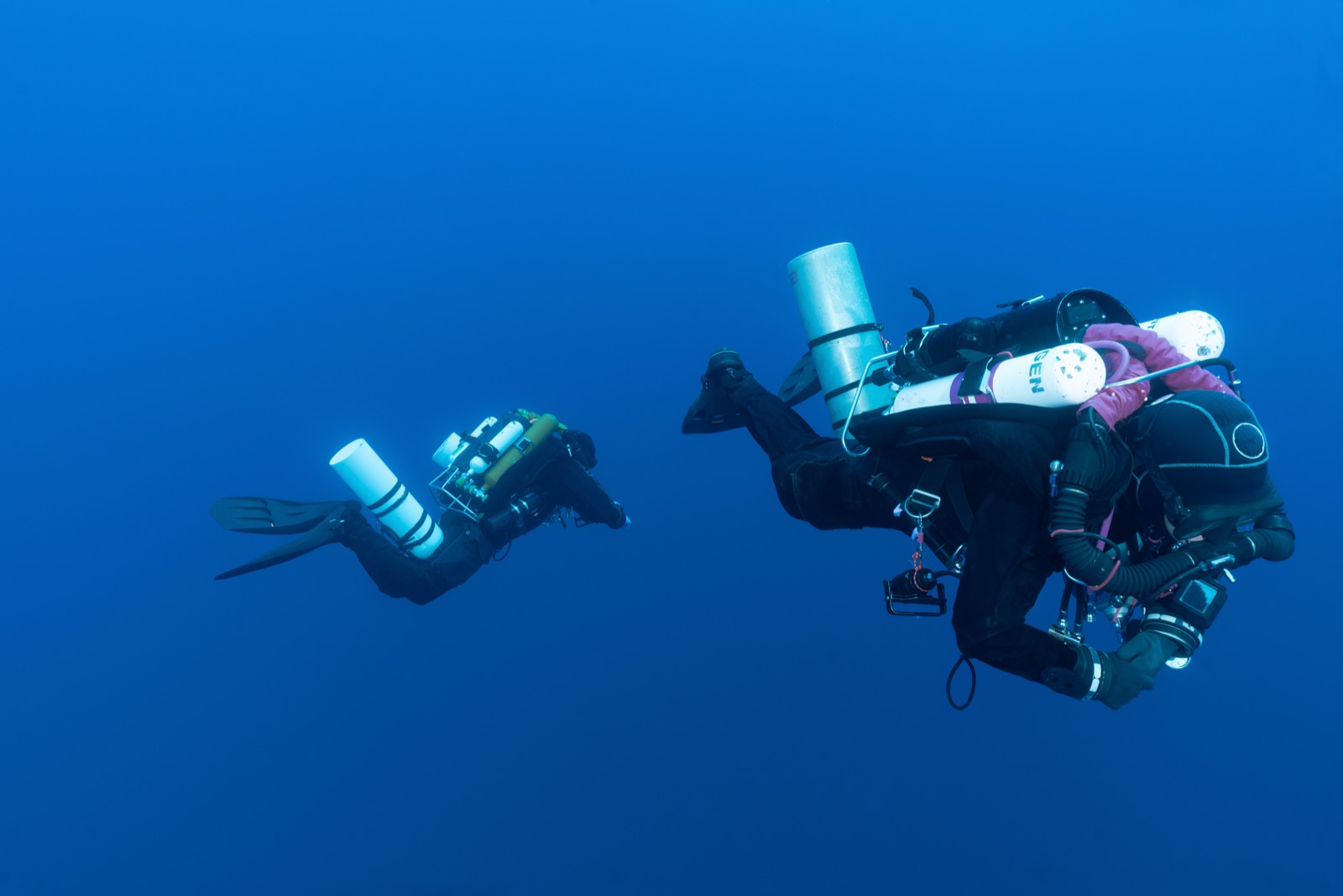
There's no fixed up-line. The current is carrying the whole team, and a bailout emergency doesn't pause the water — it happens while you're moving. So the team plan has to assume the failure point is somewhere in open blue water with a boat that's tracking bubbles or a marker, not a mooring ball you can swim back to. A few things I treat as non-negotiable:
- Matched, donatable gas. The team dives compatible bailout mixes, and we know whose cylinders can feed whom. If my bottom bailout is bad as well as my loop, a teammate's matched stage is my backup — that only works if the gas and the fittings actually line up and we briefed it on the surface.
- Who carries what is decided before splashing. On deeper drifts the deco gas and the spare bailout are distributed across the team deliberately, not improvised at depth.
- You bail as a unit. If one diver goes to open circuit, the team ascends together at the bailing diver's pace. Splitting up in current to "finish the dive" is how a manageable problem becomes a search.
- A DSMB goes up on ascent, every time. Because we may surface a long way from where we dropped, the marker is what lets the boat find us. On a drift, the SMB isn't optional courtesy — it's how the ascending team stays connected to its ride. I'd rather shoot a bag I didn't strictly need than be a head in the chop with no boat looking my way.
Team cohesion matters more here than on a moored dive precisely because the environment is actively separating you. The current doesn't care that you have an emergency.
What I actually carry
For a standard 100-ish-foot Jupiter drift on the reefs or shallower wrecks, I'm comfortable with a single right-sized open-circuit bailout stage, analyzed and breathable at depth, with a clear team plan to ascend together and a bag ready to deploy. The math just doesn't ask for more, and hanging extra unneeded aluminum off the rig has its own costs in trim and task load.
For a deeper wreck day around 180 ft with real decompression — the kind of profile where the Esso wreck and the deeper Jupiter sites live — I step up to a bottom bailout sized for the deep ascent plus dedicated deco gas, with oxygen for the shallow stops on the longer days. The volumes come straight out of the segment-by-segment accounting above, computed at a stressed breathing rate, rounded up, and then padded. Across the team we match mixes and distribute the spares so no single failure leaves anyone short.
None of this replaces a course. Bailout planning, gas matching, and team drift procedures are things you learn and rehearse with a qualified CCR instructor on your specific machine, to your agency's standards — not from a blog post. Take the reasoning here as a way to think about the problem, then go build your own numbers with the people who certified you, and dive them conservatively.